


News & Blog
Ground Mount Solar and Water Quality: Why Installation Method Is Everything
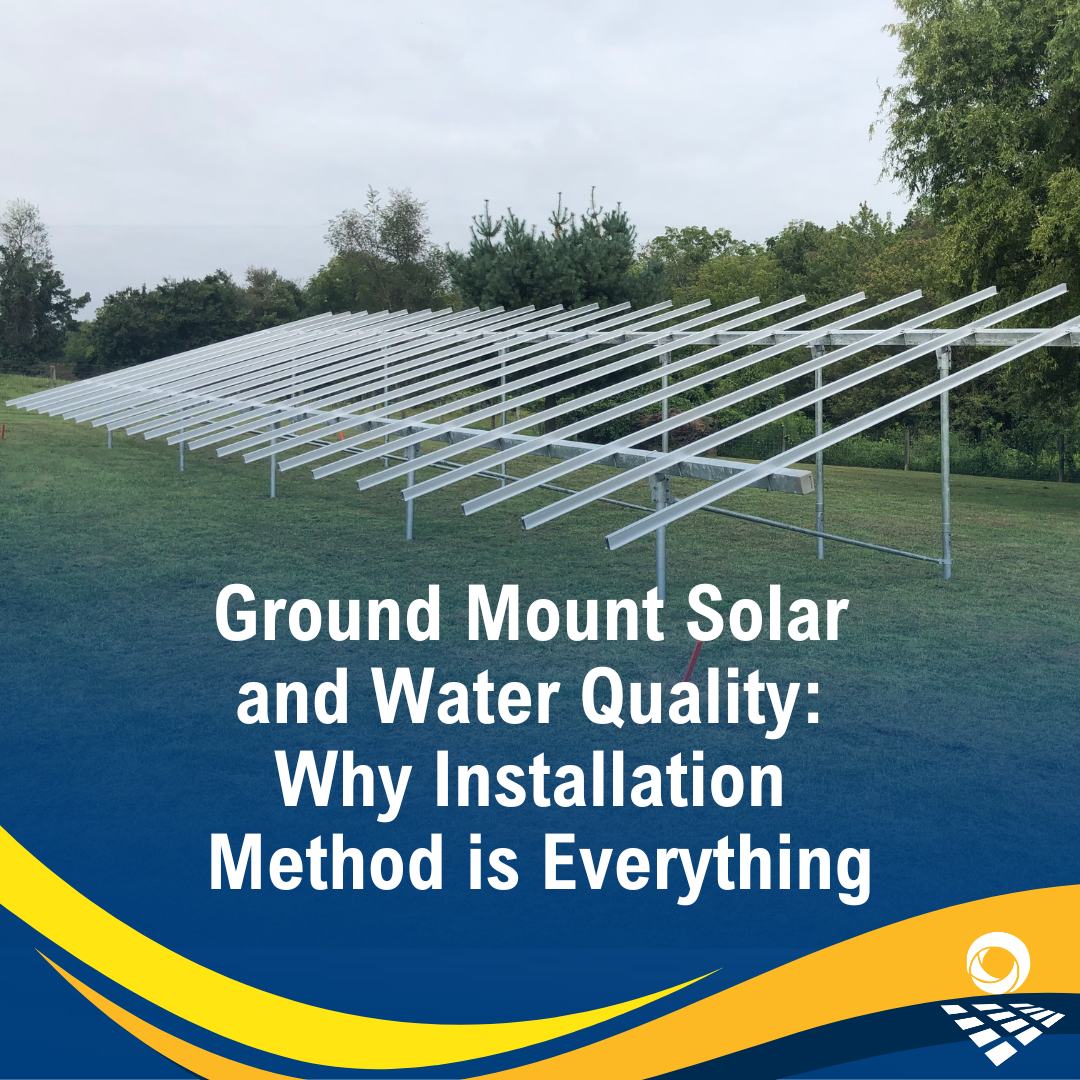
Solar energy has a well-earned reputation as a clean technology. No emissions, no fuel, no combustion. But in communities where ground mount solar projects have been proposed or recently built, a different kind of question keeps coming up: what does a solar installation actually do to the land — and to the water that moves through it?
It's a question worth taking seriously. Ground mount solar occupies real acreage. It changes how rain interacts with soil. And depending on how a project is designed and installed, it can either create water quality problems or actively support a healthier watershed.
The short version: solar energy itself is not a threat to water quality. But certain ground mount installation approaches can be. Understanding the difference — and knowing what responsible installation looks like — matters for anyone making decisions about solar, from homeowners and municipalities to the installers doing the work.
The Real Risk Isn't Solar — It's How the Ground Gets Disturbed
When people worry about solar and water, they're usually picturing runoff, erosion, or contamination reaching a stream, pond, or well. Those concerns are legitimate — but they point to installation practices, not to solar panels themselves.
Ground mount solar systems require foundations. Those foundations go into the earth. And how that happens — what equipment is used, how much soil is moved, how the site is prepared — determines nearly everything about the project's relationship with water.
Soil Disturbance and Erosion
Any construction activity that disturbs soil creates erosion risk. On a ground mount solar site, the disturbance footprint is determined largely by the foundation type. Systems that require excavation, concrete pours, or heavy equipment maneuvering across the entire site leave significant amounts of bare, disturbed soil exposed to rain. That exposed soil erodes. Eroded sediment carries nutrients, metals, and organic material into surface water. This is a well-documented pathway for water quality degradation — and it has nothing to do with solar panels specifically.
The problem isn't the array. It's the installation method that creates unnecessary disturbance in the first place.
Soil Compaction and Infiltration Loss
Heavy equipment doesn't just disturb the surface — it compacts the soil beneath it. Compacted soil loses its ability to absorb rainfall. Water that would have infiltrated and slowly recharged groundwater instead runs off the surface, picking up whatever it finds on the way. On sites where equipment has made repeated passes, compaction can persist for years and fundamentally alter how the land manages stormwater.
This is one of the most underappreciated water-related risks in ground mount installation, and it's almost entirely a function of what equipment is used and how site access is managed.
Panel Drip Line Concentration
Even on well-prepared sites, panels change how rainfall reaches the ground. Rain that lands on a panel doesn't spread evenly — it collects and runs off the lower edge in a concentrated stream. Over time, on exposed or sandy soil, these drip lines can channel water in ways that cause localized erosion. Proper vegetation management and gravel or rock placement at drip lines addresses this directly, but it has to be planned for, not discovered after the fact.
|
The Distinction That Matters Water quality risks associated with ground mount solar are real — but they're created by installation practices, not by solar technology. A well-designed, properly installed ground mount system on a prepared site with established vegetation is not a water quality threat. The question to ask about any project is: how was the ground disturbed, and what was done to stabilize it afterward? |
Why Installation Method Changes Everything
Not all ground mount systems are built the same way, and the differences matter more than most people realize — especially when it comes to water.
The two broad categories of ground mount foundation are excavation-based systems and driven ground screw systems. Their water impacts are meaningfully different.
Excavation-Based Foundations
Systems that rely on excavation — digging holes, placing concrete footings, or using large auger equipment — require significant ground disturbance. The site has to be graded, machinery has to access each post location across the entire footprint, and concrete involves water use, mixing, and curing time. The result is a substantially disturbed site that takes time to restabilize and carries real erosion risk during and after installation.
These approaches aren't inherently wrong, but they come with a higher baseline disturbance footprint that has to be actively managed through erosion controls, sediment barriers, and revegetation plans.
Driven Ground Screw Systems
Ground screw systems take a fundamentally different approach. Steel screws are threaded directly into the soil — displacing rather than removing it — using specialized equipment that doesn't require grading or site clearing beyond the installation corridor. There's no excavation, no concrete, no spoils to manage, and the equipment footprint is dramatically smaller.
From a water quality standpoint, the advantages are significant:
• Far less bare soil exposed during installation, which means less erosion risk
• No soil compaction from heavy equipment across the full site footprint
• No concrete cure time or washout risk
• Faster installation means less time with an unstabilized site
The ground screw approach doesn't eliminate the need for good site management — vegetation still needs to establish, drip lines still need attention — but it starts from a much lower baseline of disturbance.
|
How Solar Foundations USA Approaches This Solar Foundations USA uses a continuous flight ground screw —across all of our ground mount installations. The ground screw method displaces soil rather than excavating it, which means minimal surface disruption, no concrete, and a significantly smaller equipment footprint. |
The Part of This Story That Rarely Gets Told
Most of the conversation about solar and water focuses on the risks. That's understandable — the risks are real and worth addressing. But there's another side to this that gets far less attention: ground mount solar, installed responsibly, can improve a site's water quality and watershed function compared to what was there before.
Converting Degraded Agricultural Land
A significant share of ground mount solar projects are sited on marginal farmland — land that has been tilled repeatedly, treated with fertilizers and pesticides, compacted by farm equipment, and stripped of native vegetation over decades. These sites are often significant sources of agricultural runoff: nitrogen, phosphorus, sediment, and chemical residue that flows into streams and groundwater with every rain event.
When that land transitions to solar with native ground cover and no chemical inputs, the runoff load drops substantially. The soil, no longer disturbed annually, begins to rebuild structure and organic matter. Infiltration rates improve. The site that was a net contributor to water quality problems becomes something closer to neutral — and eventually, with the right vegetation, a modest asset.
Native Vegetation and Soil Health
Pollinator-friendly and native vegetation ground cover programs — increasingly required or incentivized under state solar siting guidelines in New York, Massachusetts, Maryland, and elsewhere — do more than support biodiversity. Native plants have deeper, more extensive root systems than turf grasses. Those roots improve soil structure, increase infiltration capacity, build organic matter, and reduce sheet flow. A solar site with established native ground cover manages stormwater better than a mowed lawn, better than tilled farmland, and in many cases better than the site's pre-solar baseline.
Less Impervious Surface Than Alternatives
Ground mount solar panels are not impervious surfaces in the traditional sense. Unlike parking lots, buildings, or paved areas, they're elevated, they allow rainfall to reach the ground beneath them, and the ground they sit on remains permeable. A property that might otherwise have been developed into a more conventionally impervious use often has better water dynamics as a solar site.
What State Regulators Are Watching
Stormwater management for ground mount solar is regulated at the state level, and requirements vary significantly. For installers and project owners, knowing the baseline for your state is essential — not just to achieve compliance, but to avoid being surprised during permitting.
New York
Projects disturbing one acre or more require a SPDES General Permit for Stormwater Discharges from Construction Activity and a Stormwater Pollution Prevention Plan (SWPPP). Local municipalities may layer additional requirements on top. The state has become more attentive to vegetation requirements in recent siting guidance.
New Jersey
New Jersey's DEP has developed specific guidance on impervious surface calculations for solar panels, which affects whether and how stormwater management rules apply. Installers should be familiar with the Solar Facility Stormwater Guidance document before submitting site plans.
Massachusetts
Massachusetts has been among the more active states on solar siting best practices. The Clean Energy Center has published low-impact solar design guidance, and pollinator-friendly ground cover is increasingly expected as a condition of approval in many municipalities.
Connecticut
Connecticut's DEEP applies stormwater permitting to solar projects disturbing over one acre. Additional guidance exists for challenging site types including brownfields, where stormwater and remediation considerations overlap.
Pennsylvania
Pennsylvania's Chapter 102 Erosion and Sediment Control program applies to solar sites. Local municipalities in counties like Chester, Lancaster, and Berks have developed their own solar ordinances that often include specific stormwater provisions — sometimes with thresholds lower than the state baseline.
Maryland
Maryland's proximity to the Chesapeake Bay watershed means water quality is treated with particular seriousness. The state's Pollinator-Friendly Siting guidelines and stormwater requirements are being incorporated into local permitting with increasing frequency.
What Responsible Ground Mount Installation Actually Looks Like
For anyone evaluating a ground mount solar project — whether as a property owner, a neighbor, or a planning board member — here's what responsible practice looks like on the ground:
• A foundation method that minimizes soil disturbance — threaded ground screws rather than excavation wherever site conditions allow
• A site access plan that limits equipment traffic to defined corridors, reducing compaction across the full footprint
These aren't extraordinary measures. They're what any installer serious about the environment should be building into every project. The gap in the industry isn't knowledge — it's whether these practices are treated as standard or as optional.
Frequently Asked Questions
Q: Can ground mount solar contaminate groundwater?
A: Not directly — solar panels don't introduce contaminants into the soil. The water quality risk associated with ground mount solar comes from installation disturbance: erosion, sediment runoff, and soil compaction that can temporarily increase stormwater loads. On a well-installed site with established vegetation, these risks are managed and the long-term water quality impact is neutral to positive.
Q: What's the difference between ground screw and excavation-based ground mount systems when it comes to water?
A: Ground screw systems thread steel screws directly into the soil without excavating or removing material. This means far less bare soil exposure, no concrete, and a smaller equipment footprint — all of which reduce erosion and compaction risk significantly. Excavation-based systems disturb more ground, require more stabilization work, and carry a higher baseline risk of stormwater impacts during and after installation.
Q: Does ground mount solar count as an impervious surface?
A: Generally, no — not in the way that pavement or rooftops do. Solar panels are elevated and allow rainfall to reach the permeable ground beneath them. Some states have developed specific methodologies for calculating solar panel coverage in stormwater rules, but ground mount arrays with vegetated ground cover are typically treated differently from hard impervious surfaces.
Q: Does ground mount solar increase runoff?
A: It depends heavily on what was there before and how the site is managed. Compared to conventional agricultural land, a well-installed solar site with native ground cover typically produces less runoff and lower sediment and nutrient loads. Compared to an undisturbed meadow or woodland, a poorly installed solar site could increase runoff temporarily. The installation method and vegetation management are the determining factors.
Q: What vegetation is recommended under and around ground mount solar arrays?
A: Native low-grow or no-mow seed mixes are generally preferred. Native plants have deeper root systems than turf grasses, which improves infiltration and builds soil structure over time. Several states — including New York, Massachusetts, and Maryland — have developed or are developing approved plant lists for solar sites. Species selection should account for the shading conditions under the array, which can be significant.
Q: Do ground mount solar installations require stormwater permits?
A: In most Northeastern and Mid-Atlantic states, projects disturbing one acre or more require a stormwater permit and a Stormwater Pollution Prevention Plan. Some local jurisdictions have lower thresholds. The regulated disturbance area is typically tied to total ground disturbance — another reason that low-disturbance installation methods like ground screws can simplify the permitting picture.
The Bottom Line
Ground mount solar is not a water quality problem. Careless ground mount installation can be. That distinction matters — for communities evaluating projects, for property owners choosing contractors, and for installers who want to build a reputation worth having.
The technology and the practices to do this right exist. Driven ground screw foundations, native vegetation programs, thoughtful grading, and proactive site management combine to make ground mount solar a land use that supports — rather than undermines — healthy watersheds.
At Solar Foundations USA, these aren't aspirational standards. They're how we work. If you're evaluating a ground mount project and want to understand how installation method affects the water dynamics on your site, we're glad to walk through it with you.