


News & Blog
Low-Impact Solar Construction: Building Clean Energy Without Damaging the Land
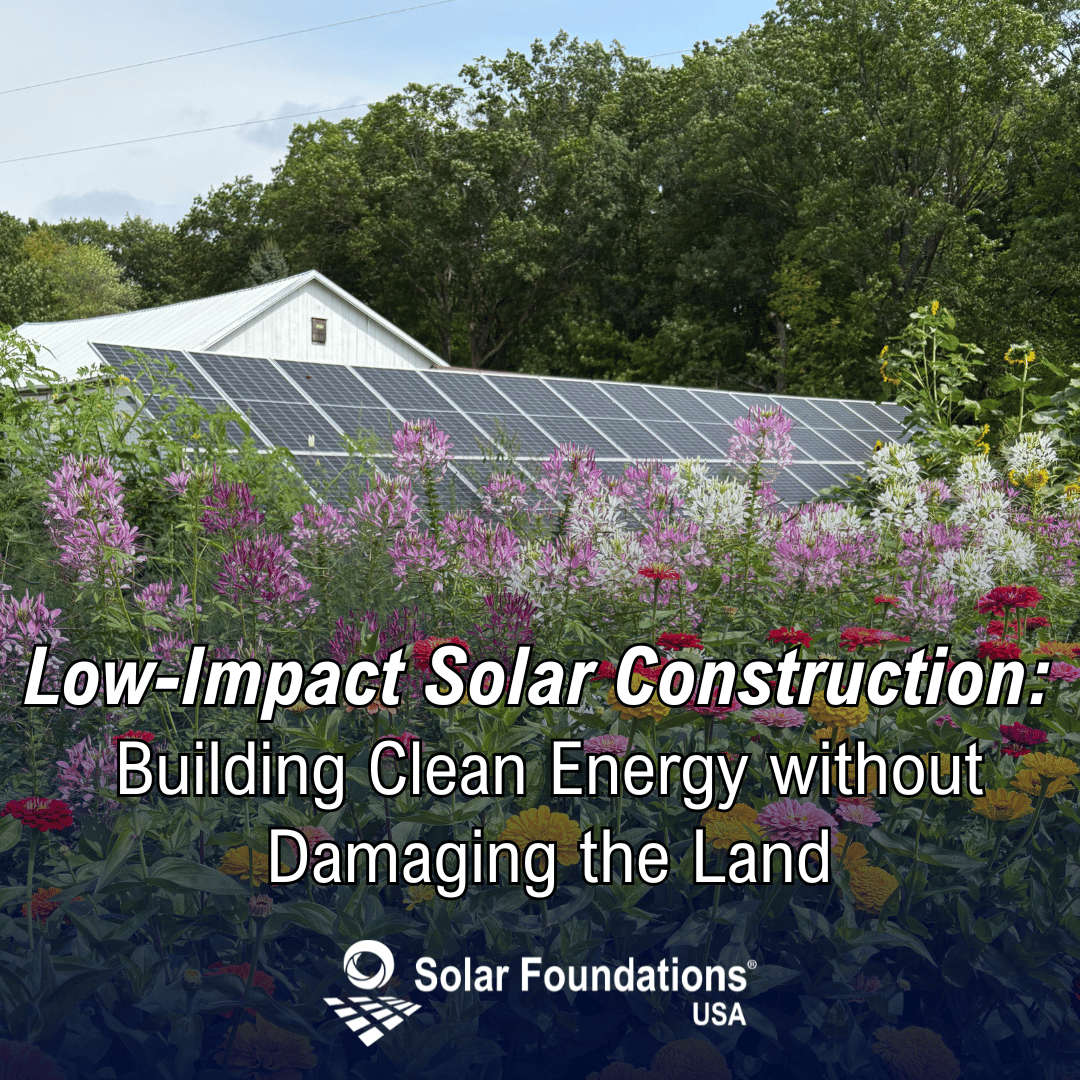
🌱 Low-Impact Solar Construction: Building Clean Energy Without Damaging the Land
As demand for renewable energy continues to grow, so does the obligation to build it responsibly. Solar energy is inherently clean — but how we install it matters just as much as the electricity it produces.
For commercial and small utility-scale projects, low-impact solar construction is becoming a top priority. Developers, EPCs, and homeowners are increasingly searching for ways to combine performance with environmental stewardship.
At Solar Foundations USA (SFUSA), sustainable construction begins below grade — with engineered ground screws designed to be installed with minimal site disturbance while maximizing structural integrity.
Let’s explore how sustainable construction practices, low-impact solar installation, and eco-friendly foundations work together.
What Is Low-Impact Solar Construction?
Low-impact solar construction focuses on reducing land disturbance during installation while preserving soil structure, vegetation, and long-term land usability.
This approach prioritizes:
- Minimal excavation
- Reduced soil displacement
- Lower carbon footprint during installation
- Faster installation timelines
- Easier site restoration if needed
In today’s renewable energy landscape, sustainability isn’t just about generation — it’s about construction methods, proper equipment, renewable materials, and lifecycle impact.
Why Sustainable Construction Matters in Solar
Ground mount solar systems often span open fields, agricultural land, or environmentally sensitive areas. Traditional construction approaches can involve significant soil disruption, heavy material transport, and longer site prep timelines.
By contrast, sustainable construction in solar aims to:
- Protect root systems and topsoil
- Reduce erosion risk by minimizing disturbances
- Limited heavy equipment usage
- Preserve stormwater drainage patterns
- Maintain future land flexibility
This is especially important for agrivoltaics, grazing land, and projects where long-term land health is a priority.
Eco-Friendly Foundations: The Critical Difference
The foundation system is one of the most impactful decisions in ground mount construction.
Engineered ground screws offer a significantly lower site impact compared to traditional foundation approaches because they:
- Require no excavation
- Produce no spoil piles
- Avoids curing time unlike concrete
- Minimize ground disturbance
- Can be removed at end-of-life
This makes them an ideal solution for homeowners and developers seeking eco-friendly foundations that align with broader sustainability goals.
How Ground Screws Support Low-Impact Solar
At SFUSA, we specialize in precision-installed ground screws designed specifically for ground mount solar systems.
Here’s how they contribute to low-impact solar construction:
1. Minimal Soil Disturbance
These foundations are mechanically installed by rotating into the soil, preserving surrounding ground conditions and reducing compaction.
2. No Excavation or Backfill
Because there is no need to pre-dig large holes, the native soil structure remains largely intact.
3. Lower Installation Emissions
Faster installation timelines and fewer material deliveries contribute to a smaller on-site carbon footprint.
4. Reversible Installation
Ground screws can be removed if the site is decommissioned, restoring the land more easily than traditional embedded systems.
5. Strong Performance in Variable Soils
With proper engineering and driven torque verification, these systems perform reliably across diverse soil conditions while maintaining structural integrity.
Sustainable Solar Site Planning Starts Early
On larger scale projects low-impact outcomes require intentional solar site planning from the beginning of a project.
This includes:
- Soil analysis and load testing
- Strategic array spacing
- Minimizing grading
- Protecting drainage paths
- Preserving natural contours
When foundations are selected with sustainability in mind, the entire construction process becomes more efficient and environmentally responsible.
The Business Case for Low-Impact Solar Construction
Sustainable construction isn’t just environmentally responsible — it’s financially strategic.
Benefits include:
- Faster installation schedules
- Reduced labor and equipment costs
- Improved landowner relationships
- Easier permitting in sensitive areas
- Enhanced investor appeal
Building Clean Energy the Right Way
Solar energy represents progress toward a cleaner future. But truly sustainable development means protecting the land that supports that progress.
Low-impact solar construction ensures that:
- The soil remains healthy
- The land remains usable
- The environmental footprint stays minimal
- The system performs reliably for decades
At Solar Foundations USA, we believe the path to sustainable energy starts with sustainable installation. Our engineered ground screw system is designed to support ground mount solar projects with precision, durability, and minimal environmental disruption.
Because clean energy should be built cleanly!