


News & Blog
The History of Ground Screws
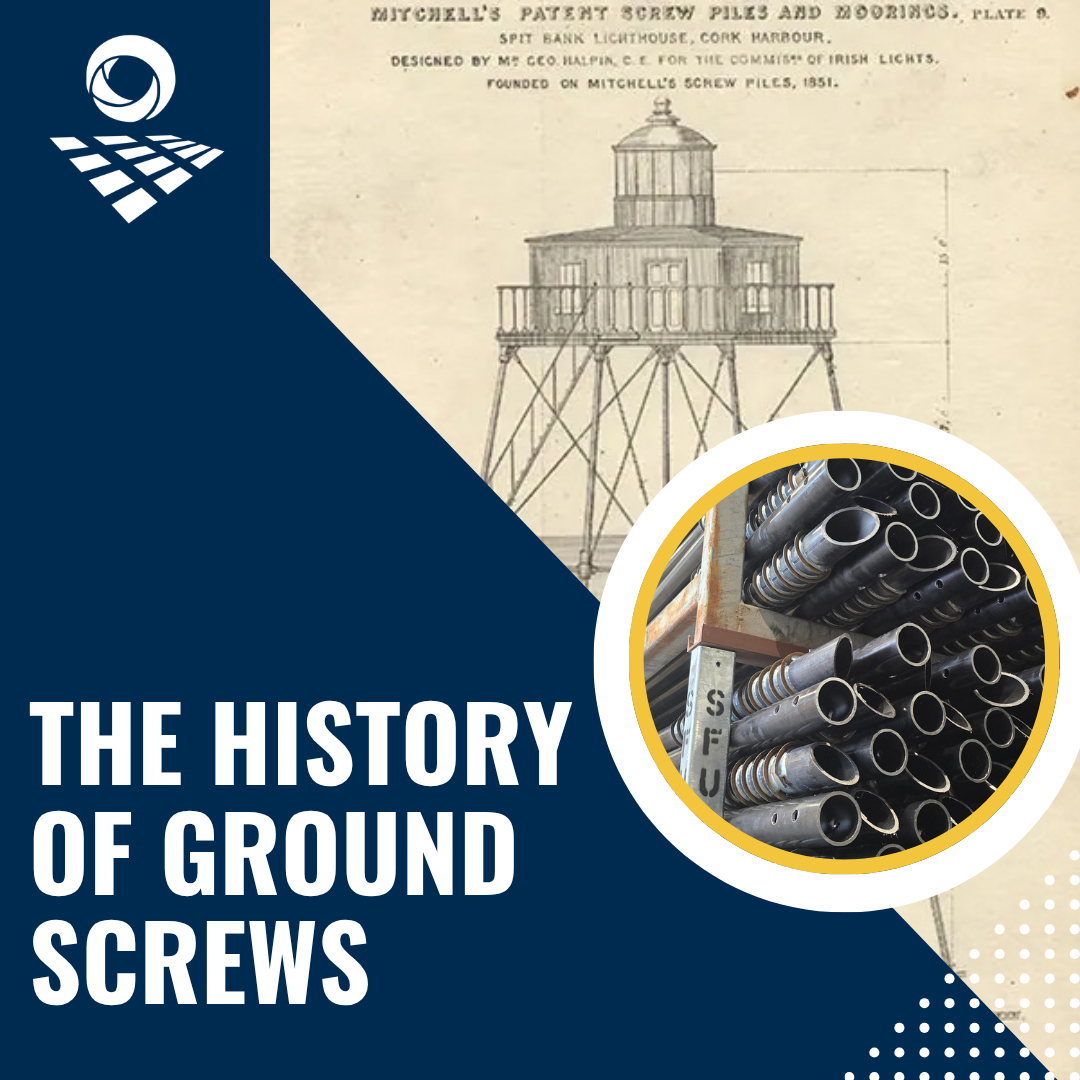
From Lighthouses to Solar Fields: A Brief (and Kind of Wild) History of Ground Screws
Ground screws trace back to 1833, when a blind Irish engineer named Alexander Mitchell patented the screw pile — a foundation technology designed to hold structures steady on shifting sand and soft mud, nearly two centuries before anyone imagined it anchoring a solar array.
A Blind Engineer, a Patent, and a Lighthouse Problem
Alexander Mitchell was born in Dublin in 1780 and lost his sight as a young man, but that didn't slow down his engineering career. Working in Belfast, he patented the screw pile in 1833 — a shaft with a helical blade that could be twisted directly into soft or shifting ground and hold firm without excavation or masonry. His timing was perfect: British engineers were struggling to build lighthouses on the sandbanks and mudflats that made coastlines so dangerous to ships in the first place. Construction on the first screw-pile lighthouse, at Maplin Sands in the Thames Estuary, began in 1838; the Wyre Light in Fleetwood, built using the same method, became the first screw-pile lighthouse actually lit, in 1840.
From the Thames to the Chesapeake
The idea crossed the Atlantic quickly. Screw-pile lighthouses went up throughout the Chesapeake Bay, where soft estuarial bottoms made traditional foundations difficult, and along river entrances in North Carolina's sounds. Many of these structures shared a distinctive look — a hexagonal cottage-style lighthouse perched on a forest of angled iron legs — and engineers soon adapted the same screw pile principle for piers and bridges facing similar ground conditions.
A Century of Quiet Utility
Through the 20th century, screw piles kept showing up wherever engineers needed a load-bearing anchor without pouring or curing anything: docks, boardwalks, transmission towers, and pipeline supports. The appeal never really changed from Mitchell's original insight — twist a helical blade into the ground, distribute the load across undisturbed soil, and skip the wait.
Ground Screws Meet Solar
Modern engineered ground screws are direct descendants of that 1833 patent, re-engineered with today's steel, coatings, and load calculations for a very different job: anchoring ground mount solar racking. The core principle hasn't moved an inch — twist a helical blade into the ground, transfer the load, skip the excavation. SFUSA's HP-Drive System ground screws carry that same engineering lineage forward, purpose-built for the load and site conditions solar arrays demand.
Why the Idea Still Works
- Fast to install, with no curing time before load can be applied.
- Minimal ground disturbance — a real advantage on active agricultural land.
- Reliable load transfer across a wide range of soil conditions.
- Removable — pull it out, and the ground largely returns to its prior condition.
So the next time a crew is driving ground screws into a field for a new solar array, they're using engineering that got its start holding a lighthouse steady in the Thames Estuary in 1838 — proof that some good ideas just keep finding new work.
Like+Follow for more content.